Tuesday, July 17, 2007

My First Natural Dye Day at Home


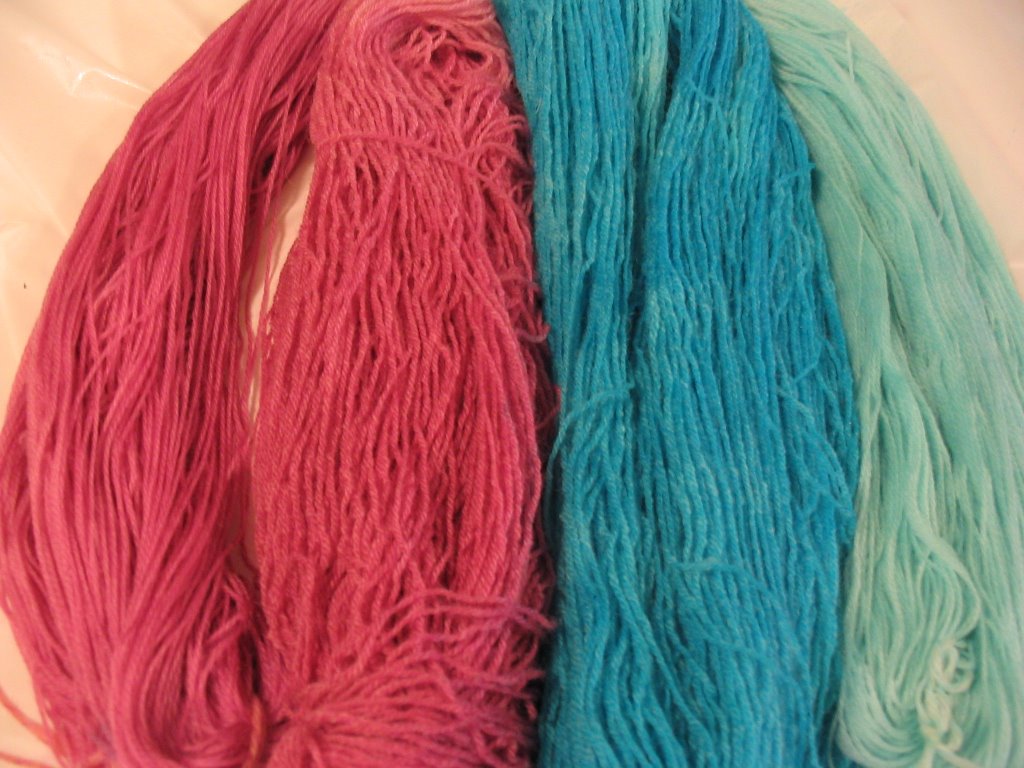
After that wonderful workshop at MAFA just after July 4th, I shaved the Lilly of the Valley bed and made up a dyepot. Attached is a picture of three batches which came out of the base of Lilly of the Valley. Yarns for 1, 2, and 3 were pre-mordanted with alum and cream of tartar. Batch 2 had cochineal added to it, and 3 had iron added. Some were dipped in an afterbath of ammonia, which deepened color in most cases, and turned one skein yellow.


Then, I was so happy out in my yard cooking up colorful yarn that I cast my eyes about and just couldn't picture any of my other garden plants winding up in the pot. I ran upstairs and ground up 3/4 of a pound of good Latin American coffee, and came up with some wonderful browns. Batch 4 was dipped in ammonia afterbath, and 5 was just the exhaust. You'll notice some are brighter than others, and those are superwash yarns.


I did attach a picture to the former entry where I wrote about the MAFA class with Carol Wood and Debbie McCrea. Check out the samples!

Monday, July 09, 2007


MAFA Workshop -- Natural Dye

I am back from a wonderful workshop put on by MAFA (Mid-Atlantic Fiber Arts) and held in northern Pennsylvania at Merrywood University. My teachers were Carol Wood and Debbie McCrea, and there could not have been two more talented and enthusiastic examples of dye artists.

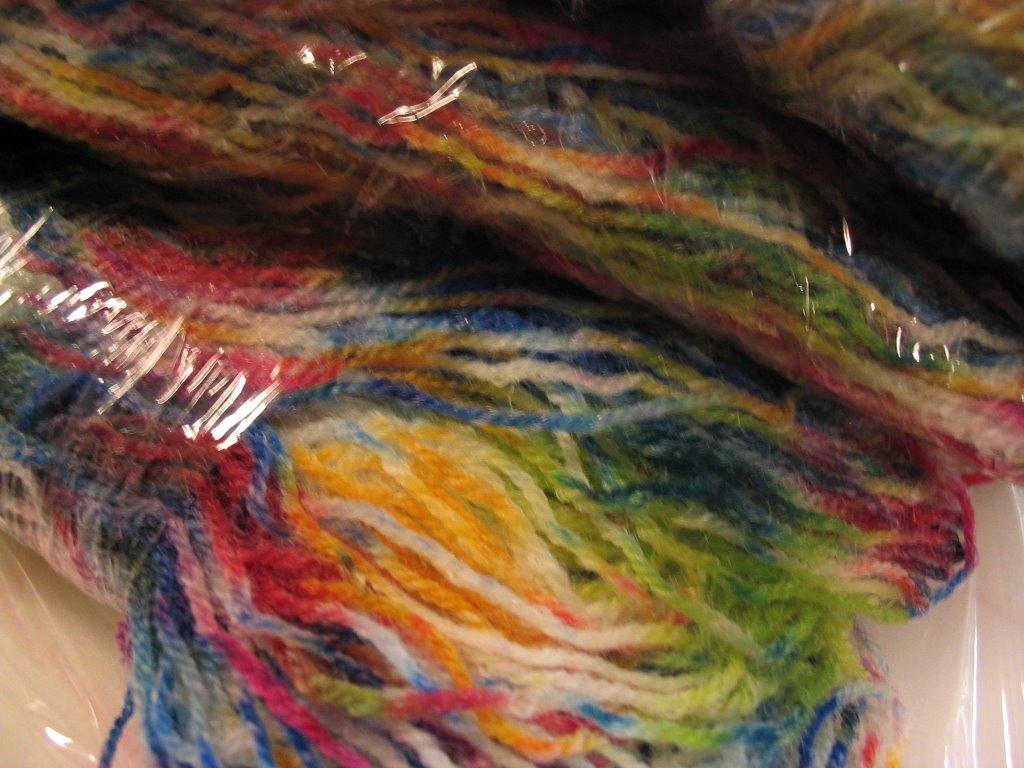
We created 64 different colors, using 50 gram skeins. The dyestuffs were onion skins, cutch, brazilwood, osage orange, weld, logwood and indigo. Carol and Debbie had already done the mordant phase in preparation before the class began. Each of the dye pots had 3 skeins done in alum, chrome and tin, and from there the skeins went off to be overdyed in other pots, or to be dipped in either vinegar or ammonia. Without the skeins being marked with a code and matched to their chart, I can see that we seven students would have been confused easily.

Maybe that chart represented one of the valuable lessons of the workshop. Taking notes and keeping yourself organized is absolutely essential in a big experiment using so many different dye stuffs and mordants. We had each, at the instruction of our teachers, brought with us one gallon of our own tap water and did individual experiments to see the difference between our tap water vs. the use of distilled water. That was an opportunity to weigh out the tiny amounts of mordants, and I was glad to get that chance. I think that my fear of natural dyeing has always been about measuring some of the elements used in the process, but this experiment took the fear away entirely.

After all was dyed and dried, we tied samples to a tipcard so we can always see and fondle our results. The tip card, by the way, was coded to the chart used to direct the skeins to this pot or that dip in the actual dye process.

I bought copper, alum, cream of tartar and iron (as mordants). Also, sawdust from brazilwood and osage orange, cutch, cochineal to start my own experiments. Perhaps my new dyeing friend, Lara, and I will grow in our skills as Carol and Debbie did as they began to dye together. At least that's the plan!

On the last evening, our class participated in the fashion show. We all wore black and draped ourselves in the skeins and in three silk scarves which we had also dyed during the workshop. We walked up on stage and struck poses, with our backs to the audience, and on Debbie's count of three turned to face the audience and reveal the colorful splendor of our skeins and scarves. For some reason we all were working the mental image of The Supremes! What a roar of laughter and a sea of smiling faces met our performance. Lightbulbs flashed, applause spread across the room! We were a hit!

Well, Debbie and Carol were the hits. They are just terrific. I would take another class from either or both of them in a flash.

One of my classmates is sending digital pictures to all who participated, so when that arrives, I will post it with these paragraphs.

Tuesday, June 26, 2007

Superwash method

One of my customers recently wrote to me about the superwash process. Basically, this is a chemical application applied to wool fiber and it essentially strips away some of the cells lining the shaft of each fiber, leaving it exposed. This means that the little cells which line the fiber shaft will not rub against each other and catch, causing felting or fulling. Also, since more of the actual shaft is exposed, a superwash yarn will be a more vibrantly dyed fiber.

What was so interesting about this email was that my customer had attended a lecture at Maryland Sheep & Wool Festival about fiber processing. The speaker said that there was a superwash process which individuals could actually at home in their washing machines. Then, they said it was a government secret. I couldn't get if this was a joke or not! BUT if you know about such a process, please, please let me in on this secret!

Tuesday, May 29, 2007

ALMERINO = Alpaca + Merino


Almerino is a soft yarn blend of baby alpaca and merino -- luscious! These five colors are closeout yarns, packaged 10 wound balls to a bag. They come in two weights: ARAN, with 533 yds per package and DK, with 615 yds/pkg. This is a one-time purchase and I was not able to secure many of them, so if you want them, check out the details on the SPECIALS page of the website, or email your question to info@wool2dye4.com.
Note made on July 25, 2007: I have taken these yarns off the website, but they are still available. The cost is $10 per bag, and the reason for the low price is that there are little knots in this yarn every 20 yards or so. It is a wonderful yarn, but the knots might put people off. I am doing a sweater in the Sugared Almond blue, and the knots are easy to hide on the wrong side. If you are interested in this soft, yet slightly flawed yarn, email me.
The colors are Grape, Custard, Strawberry Cream, Gooseberry, and Sugared Almond. They are spun in England.
So! give yourself a little rest and knit up something very nice in these comforting colors.

Thursday, May 24, 2007

Further reading on the Merino shortages

To read further about the shortage, follow this link:
http://www.wool.com.au/Trade_News_and_Media_Releases/Media_Releases/page__7561.aspx

More on Australian Merino availability

In an earlier post, I wrote about an Australian fiber artist who publishes a magazine (called Yarn Magazine) and writes extensively about yarn from the ground up, so to speak. We exchanged emails about my questions on the shortage of Australian merino, and she posted my letter on her blog.
There were many comments in reply to that entry, and most concerned two issues: the droughts, which have affected the feed available for the flocks, and the fact that Australians are not marketed to as a viable merino customer base. Here is the link to that blog for a broader view of the merino situation:

Wednesday, May 23, 2007

Interweave's State-by-State Directory

Every once in a while, a customer writes to me asking if I know of a knit shop near their home. This week, someone was moving, so I forwarded a link to Interweave's Traveling SourceBook. Here is the link for your own use:

Testing new Merino


Lately I have been widening my search for the perfect sock yarn, and am testing three new superwash merino yarns. Some of my regular customers have volunteered to serve on this Yarn Review Board, and have sent excellent comments to help me make the decision.
The reviewers' comments are fascinating, and it turns out that the way we each define the perfect sock yarn is slightly different, yet has some basic similarities such as weight, roundness of yarn, and whether it splits when knit.
Look for a summer announcement of a new line of superwash merino. Once the votes are in, my business will import enough for all of us. One of the qualities of the perfect sock yarn for me is availability year round!
Comments are always welcome.

Thursday, May 10, 2007

Sheila's Basic Sock Pattern

A Word about Socks

My favorite sock needle is the 12" Addi Turbo circular in size 2. I cast on and rib, back and forth, for about an inch, then join the ends by switching the first and last stitches. Then it's round and round, in any pattern. Staying with the same circular needle at the gusset, I increase one stitch at both side markers, every other row until I like the depth of the heel. To turn the heel, I just move directly to the center back, and begin the short rows. Neat and easy! When it's time to decrease for the toe, I switch to two 24" circulars, positioning the stitches so that the decreases fall in the center and not at the edges. To end, reposition the stitches one more time on the 2 circulars, and turn the sock inside-out for a three-needle bind off. A sock is a small engineering project!

Back to shipping by USPS

Ok, I tried UPS and learned lots, but am returning to the good old Postal System for shipping most orders by Priority Mail. The difference in price and delivery time is the deciding factor, and when some of my good steady customers began to complain of delayed delivery, I was pushed to make a decision.

One thing I did learn is that shipping to Canada is so very much easier with UPS than with the US Postal System. In the future, I'll ship all orders to Canadian customers by UPS Standard service.

For US customers, I am back to Priority Mail. It's a good service, but I had been avoiding the bad mood of my pickup man and was loading and unloading each day's orders. The business has grown so much in the past year that shipping had begun to take up most of the day, and that loading and unloading became a chore.

Begining tomorrow, I will steel myself for any bad moods with my local pickup man, and return to shipping by USPS Priority Mail.

PS on May 11, 2007
A few Canadian customers have emailed me and one responded below (see comments) that UPS is not a good option for them because of the duty they must pay. I have always felt a flush of guilt roll over me when I have to charge Canadian clients the postage. It is outrageous! Your emails and comments help so much as I try to serve this customer base efficiently. This is how we learn. Thank you for letting me know.

I was looking for a way to avoid a trip to the Post Office to stand in line. I have just signed up for Carrier PickUp and will ask if I can just hand over Canadian packages in the future.

Friday, May 04, 2007

Interweave KNITS Features Socks, summer 07

The latest issue of Interweave's KNITS magazine arrived this week. Happily, there are three -- count them! -- articles on sock knitting, all by Ann Budd. She is a designer whom I would love to meet. So creative, Ann Budd writes in a clear and conversational style, practical designs.

There is also a review of six sock knitting books by Clara Parkes, also a wonderful writer and entrepreneur/founder of Knitter's Review.

I am still fascinated by the question of which hand-dyers were interviewed for the fall issue of Knit Simple. This is a Vogue publication. It is wonderful to see the big time money folks at Vogue giving the nod of recognition to independent hand-dyers. If anyone has any inside info on the artists' work featured in this issue, please tell all!

Wednesday, May 02, 2007

YOU-TUBE Video features Yarn!

This link to a You-Tube video was sent to me by Ann McCauley, author and teacher of knitting nationwide. It is delightful!

Friday, April 27, 2007

Folk Life at Pharsalia Plantation April 07


This picture is of Judy Adams, a friend and talented fiber artist, who accompanied me to Nelson County Days on Saturday where we were costumed and fit to create a little folk ambiance, sitting outside the spinning and weaving house. On Sunday, another friend, Ann Vonnegut, brought wool from her Leicester sheep and she spent the day spinning and inviting people to dip their hands into sacks of raw wool 'in the grease' and then into some cleaned and combed rolags. This all happened at a folk life festival held at one of the last remaining intact plantations in Virginia. I always think it is interesting that men seem willing to try their hand at weaving a throw or two, or at mastering the drop spindle. Several boys took to the drop spindle in lots less time than I did!

You might notice that the gentleman at the loom has on a red/maroon remembrance ribbon, and this is because the festival happened just 6 days after the tragedy at Virginia Tech. Nearly everyone in central and southwest Virginia has a connection of some sort to this school. If your dog or horse is sick, you cart them off to the veterinary school at Virginia Tech. If you need your soil tested, you send it to them. My uncle graduated from that school, and I graduated Radford, just 10 miles away, and at that time known as the women's division of the university. This part of Virginia is a Tech football bastion, and just across the historic James River begins the emotional loyalty to the University of Virginia's Cavaliers. We have attachments to one or both of these schools.
The day of the folk life festival at Pharsalia, I noticed many outfits in the crowd which were put together in variations on the red/maroon Va Tech colors, a reminder of truly awful things while we sat and wove and spun and talked to passers by, all in the shadow of the Blue Ridge Mountains, outside a gracious Southern plantation house perfectly set on a knoll and overlooking hundreds and hundreds of acres of apple orchards, pastures laid out logically to allow movement of cattle across the land, two creeks cutting through the pastures with walnut and locust trees overhanging the bends and curves.

It was a mixture of old and new in so very many aspects.

It occurs to me to tell anyone reading this and who may not have been to Virginia, other than a quick pass-through on the north/south routes, I-95 and I-81, or the east-west Interstate route 64, that this is one of the states in our country where a bit of the old colonial history lies around the next corner. I have lived in Virginia, Italy, Mexico, California, and finally made my way back to Virginia again, and I absolutely love it. I know my roots are in Virginia. Running through my town, the James River winds its way to Richmond in one direction, and through mountain passes to eventually join the New River in the other direction. Every single time I cross the river, I say out loud in my car -- no matter if I am alone, or driving Mr. PeeWee to the dog groomer -- I say, "Ja-a-a-a-mes River!" I love saying that. Sometimes I get a quick flash of a memory of the grade school stories of children walking along a corduroy road to school, or think of the bateau festival that starts here in Lynchburg and winds it's way, literally, to the capital of Virginia, Richmond, when, during that two weeks, the boatmen-and-women are reliving a part of our country's early history, every town and village along the way comes out to greet the floating boats, or to put them up in tents on their land along the banks of the James.
If you come to Virginia -- and you must! -- please get off the interstates and drive the old roads because that is where you will see bits and pieces of history, preserved and lived in every day life. When I stopped at a country store after the festival, wearing my colonial dress and apron and bonnet, and walked along oiled pine floors creaking beneath my feet, made my way to a cooler in the back to buy a Starbucks Double Shot drink, no one looked at me twice. I could have been wearing my usual jeans, but my colonial costume somehow did not raise any interest at all. And suddenly, all those yards and yards of fabric getting in my way and wadding between my knees every time I moved, seemed a perfectly natural dress to wear on a late Sunday afternoon in the mountains.

All of this to say that our crafts are pieces of the old ways, our movements are remembrances of women and men who made those same movements and wove and spun and knit and dyed and sheared and combed wool and nursed new little lambs sometimes to health and sometimes not. What we do is important. Every time we turn towards these fiber arts, we are a little tiny representation of a living folk life festival, all to ourselves.


Friday, April 20, 2007

UPS, Here I Come!

Starting next week, I am going to try out USP as my shipper. Getting out the orders in late afternoons has become a real rush, and so I signed up for a retail UPS account. This way I can leave packages outside the studio door and not have to stand in line at the Post Office.

For the next month, then, I will be using UPS ground service for shipping the orders, unless the mailing address is to a post office box. In that case, I'll continue with USPS Priority Mail.

At this point I cannot accurately compare the costs of shipping between UPS and USPS, but if it does prove to be cheaper -- as UPS assures me! -- the shipping costs will be changed on the website.

Hopefully, this will put a stop to the mad afternoon rush to ship and the frustrations of wasting time standing in line. I will give UPS a one month trial and if all goes well, will change over to them permanently.

Thursday, April 12, 2007

American Bald Eagle: Live camera shots

I know, I know that I say all of the posts on this blog will be about Wool2Dye4, but today I make one exception ... the American Bald Eagle's nest at the Norfolk (Virginia) Botanical Gardens. This is a link to a live camera trained on a nest of three, and it is fascinating. I don't know how long the link will be active, but here it is for now.

New! Superwash Blue Faced Leicester Roving


I am expecting an order any day now from England and the Blue Faced Leicester folks. This time I am trying out the BFL Roving in Superwash.


Several spinners of sock yarn have been asking for superwash BFL rovings, and now we have it. It will soon be posted on the website, but until then, just email me (SheilaMahone@wool2dye4.com) to order.


Cost: $25 /pound.

Wednesday, April 11, 2007

Knit Simple magazine Features Hand Dyers!

I was recently contacted about advertising in Knit Simple magazine's upcoming issue, and am happy to report that they are featuring hand-dyes in the Fall issue. Here is the blurb for that issue of Knit Simple ...


TO-DYE-FOR KNITS You won’t be able to resist these classic sweaters in delicious yarns from the industry’s best hand-dyers.

Now, which hand-dyers would a Vogue publication consider 'the industry's best hand-dyers?'
Is it you?

P.S. on May 10th ...
Just found out that Lorna's Laces is one of the featured dyers for this issue!

Monday, April 09, 2007

Kona Fingering is coming .. I promise!

Today I heard that Kona Fingering is soon to be on it's way to Wool2Dye4. Hooray! When it arrives, I will take the blocked order key off the website, and insert a message across the top of HOME page (where the messages crawl across the page). It's been a long wait for this merino from Australia, and we have all been faced with either changing our choice of wool, or learning to wait. BUT the good news is that it will be here in about a week.

Many customers decided to swap their backorders for Kona Fingering for the new BFL Ultra! yarn, and I am hearing back from them that they love the Blue Faced Leicester. Thank you to everyone who was so gracious through the backorder wait. Let's see ... that would be everyone except for one person who seemed unable to wait and needed someone to blame. That, of course, turned out to be me!

Emails: Help me Identify you

Here's a simple request and one which will absolutely help me out. When you write with a specific request, please sign your emails with your first and last names. Many times customers have creative email addresses which have nothing to do with their names, and they sign their emails with their first name only.

This will save me searching through old emails trying to find a place where you might, just might, have given me your full name. Or, worse, searching through PayPal to match your email address to a name. If you are requesting that I send you something, please give me your address in the original email. That helps!

This simple act will save me hours!

Thursday, April 05, 2007

Compare dyed / undyed Konas & BFL Ultra! yarns

One of the most frequent questions I get from new dyers is about the thickness of the yarns, so I thought I would post a picture of the three most popular sock yarns side-by-side. The top two are the Kona yarns. Yellow is the DK/light sport weight; green is Kona Fingering. Pink is BFL Ultra!

All three are superwash yarns.
All three bloom/expand/fluff up when dyed or given a very hot bath.

Kona Fingering has 2,240 yards per pound, and is a 2-ply.
Kona Superwash has 1,120 yards per pound, and is a 4-ply (Basically double the weight and plies of the Fingering)
BFL Ultra! has 1,900 yards per pound, and is a 3-ply.

Kona Fingering and Kona Superwash are merino yarns from Australia.
BFL Ultra! is Blue Faced Leicester from England.

Which one you choose depends on your preferences. I have read in people's blogs who have written that the BFL Ultra! is thinner than the Kona Fingering, and I'd disagree with that observation. The difference in yards per pound is one clue, but the most telling difference is in the number of plies. Kona Fingering is actually much more loosely twisted than BFL Ultra! making it not as firm and round a yarn.

I know I keep talking about round firm yarns because it is important to understand how a yarn will act when knit into fabric. Round firm yarns give more detail to the stitches, especially if there are cables or ribs involved. Also, the fabric itself has a better hand.

Of course, it all comes down to personal preference. Price may figure into the equation, too. Remember, though, you pay for what you get, and while the BFL Ultra! is a little more expensive than Kona Fingering, it is a different breed, a different ply, a different twist.


Thursday, March 29, 2007

U.K. National Knitting Week Pix


Author and knitting teacher, Ann McCauley, of Colorado -- and originally a Virginia gal! -- sent this link to a public relations event in England. The picture above is a unique weaving loom from this site. Click on the link to see a wonderful variety of needlework that is innovative, beautiful, and inspirational. Here goes ...

Tuesday, March 27, 2007

Merino Shortage from an Australian's Viewpoint

I recently stumbled across a wonderful site and new magazine.. well, new to me, but I ordered a subscription and all of the back copies. Here is the link to Barbara Coddington's blog and magazine info: www.yarnmagazine.com.au

This merino situation has me fascinated and frustrated at the same time, so I wrote to her to see what her thoughts on the subject are. She has given me permission to use parts of her letter, and I think it will make interesting reading for American merino knitters who are experiencing the frustrating wait for Australian merino yarns.

Hi Sheila,
That's a very interesting query. I have been looking into it a bit for my own research and writing purposes, and I think I can give you a short answer.
As you already know, we've had a series of droughts in Australia. Flock size is down over the last several years and overall, wool production is down somewhat. I don't believe the situation is considered a sheep shortage, however.
What has changed quite a lot, though, is the type of merino available. There's actually been an overall increase in the finest quality merino fibre (19.5 microns and under). Some of this is known as 'hunger fine' wool and is due to poor nutrition in the sheep due to the drought -- they produce less robust fleece when stressed. But some of it is also due to really good growing conditions a year or so ago in parts of Australia. It can take awhile for the seasonal ups and downs to trickle into the market.
So the combination of there being fewer sheep and each sheep producing a bit less wool which is finer than usual means the increase in fine merino has come at the expense of middle range merino around 21-22 microns which I imagine is what may be back ordered in NY.
I can't comment on the marketing campaign you mention as we are not subjected to it here! The Australian market is quite small and I feel the global market is usually the main focus of their efforts. (As you've seen in my blog already.)
Looking through the return comments on Barbara's blog, it is evident that many Australian knitters have a hard time finding yarn in one of the largest merino producing countries in the world.

Monday, March 19, 2007

Selling Your Hand-Dyes

To get started with selling your handdyes, you could go the eBay or ETSY route. Lots of my customers do that and it is easy to set up. The other route is to find an owner of a local knit shop who is looking to stock some different yarns than everyone else has. They are definitely out there, especially as the popularity of handdyed yarns begins to penetrate the general knitting public's consciousness. New shops are a good place to make that connection, or shop owners who are innovative themselves. You need to come up with a set of samples, a list of your prices, and an agreed upon policy about color matching. That is so hard, but being a scientist, perhaps you have solved that problem.

Try to compete with a best seller in your area. I have two personal examples, one of which I followed through with, but will not repeat because it would be like starting a new business for me and I just cannot take on any more work just now. We have a shop owner in a small town nearby who is a master knitter, has been to the conventions for years and knows all the designers, takes the big classes, etc. When she opened her shop, her vision was to carry yarns that you don't see everywhere. We talked about me supplying my handdyes to compete with a popular light sport weight yarn (which starts with a "K"). That's her best seller, but hard to reorder without an extended wait. Also, even though they use the same numbers for their colors, the dye lots cannot be counted on to match. The other was a new shop, opened by a former yarn rep, and he, too, wanted lines that are not all over the place. He was targeting the beginning knitter folk and giving lessons for small projects to reel them into his new shop. Sock yarn was his thing, so I dyed up 3 dozen skeins and he loved them and they sold very well. I didn't follow up quickly enough with the first shop, and also didn't present myself well, I now know. My presentation was more polished with the second shop I described -- samples of dyed and undyed yarns to show fiber choices and colorways. Price lists. Discount policies. Suggested retail pricing. That sort of thing.

The other way to go is to dye up as much yarn and spinning fiber as you can manage, and to attend a local fair, a fiber festival, a small business expo, etc. There are always fiber folk in every crowd, and you will sell yarn at events which are not related to our field at all. Better, of course, if it is at least on the artsy side of life. Sometimes there are events open to the public for privately owned historic properties, and they might be open to the idea of a quaintly dressed fiber artist selling baskets full of colorful yarn. You will never know unless you ask. AND, you'll meet some interesting people along the way.

Wednesday, March 14, 2007

BFL-DK ... My new favorite yarn?


With so many yarns and samples, I try to experiment with each one so that I can have a feel for some of the properties of the yarn. I'm looking for how it feels as I knit, how needle sizes create tighter or looser fabrics, how the yarn absorbs dye, what changes in the yarn occur during the dye process or just from a hot bath.


I had worked my way through the Blue Faced Leicester yarns on the website, and two weekends ago decided to gift myself a cone of the BFL-DK, a round creamy 4-ply. Boy, was I in for some fun! This yarn has enough heft to it to make you actually feel the yarn as it slips through the fingers. It is so very soft and knits into a beautiful fabric.


Elizabeth Zimmerman's patterns fascinate me, so I decided to try the BFL-DK on her Ganomy hat pattern (from Knitting Almanac, from Schoolhouse Press). The Ganomy pattern neatly places increases at the ear level and decreases at mid-forehead to give a comfortably curved hat. The picture above is of the hat as it reaches the point where I must divide the work onto two circular needles. It was knit on US Size 8's, and I will do the next one on size 7's for a little firmer fabric. Unfortunately this hat is too small for me, since it is lighter than the weight that EZ used for her Ganomy. I'm going to increase the next hat by 8 stitches, and place markers according to the percentage of distance between markers on her original pattern. Hopefully, I will come out with something I can wear to keep my head warm when I go to an April event in central Virginia. It looks sort of like what Colonial women would have worn, right? Oh, well. I'm planning to get away with it, even if it has to be worn under my colonial bonnet, as I head up a group of spinners, weavers, knitters and fiber processors (is there a better word?) in the old Spinning House on one of the few remaining plantations in the area. Should be fun!


This sounds like I have actually constructed a bonnet and a costume, but that is not the case at all. In fact, just writing this, reminds me that I need to pull the fabric and pattern out and get to work!


But, back to the yarn. I think I like the DK weight because it is not too heavy, and I can see doing one of Karen Alfke's Top-Down sweaters in it, and in the natural ecru, too. This cone that I gifted myself is not even from the new batches which are being processed in Italy and have even more loft and luster showing through! Imagine what that next batch will look like. Luscious!


This is the reason some people call Blue Faced Leicester 'the poor man's cashmere.'

Friday, March 09, 2007

BFL Ultra! now in one-pound skeins

A new shipment of BFL Ultra! arrived today. Unfortunately, the new mill wound our skeins into one-pound skeins, instead of the usual 8 oz skein. We'll just have to try out the one-pound skein of this great yarn until the next regular shipment of 8 oz skeins comes in.

One pound of this yarn has 1900 yards. It is a 3-ply superwash in the 'poor man's cashmere' yarn, Blue Faced Leicester, nice and round and blooms just a little when dyed/steamed/washed.

The 8-oz skeins will be back in stock around April 15th. Until then, we have this yarn in one-pound skeins and one-pound-plus cones.

$46.40 per pound.

When filling orders after the new shipment, I wrote a note of apology to a customer about the larger skein. She responded immediately, 'I love the larger skeins!' I am sorry if this is inconvenient for anyone, and promise you that my exporter and I are working to get new 8-oz skeins back into regular stock.

Tuesday, March 06, 2007

Let's Organize a Write-In Campaign to HGTV: Bring back Knitty Gritty and Uncommon Threads to the Morning Schedule!

OK, Knitters and crafters out there! Let's show the power of the needle or the power of the computer ... you pick! I invite everyone who reads this blog to write to HGTV and ask them to put the only knitting show on their lineup back into the mid-morning schedule, Knitty Gritty and the other show that features all sorts of needle arts, Uncommon Threads. These two great shows are now hidden in the 7 a.m. slot and have been replaced with yet another real estate program.

The world and HGTV do not need another program about remodelling/ selling/buying/lusting after houses. What the world needs is more knitting! These two shows are the only national shows that reflect our art, and they are being shunted to the early morning hours, and away from the prime morning spot they had enjoyed. I am sure this was a marketing move. Let's face it: houses cost more than yarn, though some of us could probably vie for the budget of a small house, at leaset! This seems to be another example of the artsy side of life being pushed aside to make room for the main stream to expand. Please, please join me and send a tastefully worded request to bring these shows back to more reasonable hours.

I ask you to do two things:

1. Send an email to the programming department of HGTV. Here is the link to the email comment page on HGTV's website:


http://www.hgtv.com/hgtv/about_us/article/0,1783,HGTV_3080_1433559,00.html

Scroll to the bottom of the page and click on the Customer Services link to email the programming department. This link is printed in brown and is underlined. It is hidden --- hmmm, what does this suggest? -- in the very last paragraph titled "You Still Didn't Answer My Question."

2. Contact the major bloggers and spread the message. Let's see how many people we can get to join us in this email campaing and our efforts to save the fiber arts programming.


I recall reading a well-read, well-written blog by a Canadian fiber artist about a situation within the knitting field where the everyday marketplace was shocked into recognition of the buying power of the knitting marketplace. There were literally hundreds of responses. Many people clamored to get the contact name of one of the parties involved, exclaiming (through print with many exclamation points!!!) that the world didn't know how many knitters were out there and that there was power in numbers.

Remember the old country adage: The squeaky wheel gets the grease.

Well! That's what I hope will happen now, and that this powerful number of knitters who represent a considerable buying power in the arts, travel to do our arts, publishing, advertising, etc., will make an effort to bring the programming folks at HGTV into the fold! Please write an email yourself, and spread the word to your favorite blogger, to your knitting group, to the local knit shop.

Will you join me?

Monday, March 05, 2007

Top-Down Designs in new Knitter's Magazine

The next issue of Knitter's Magazine will feature top-down designs. Wool2Dye4 carries patterns from the queen of top-down design, Karen Alfke. In fact, I started carrying Karen's UnPattern designs after I took her class at a Stitches East a couple of years ago. Finally, here is a formula to make a sweater that fits, and fits superbly! Check out all of Karen's patterns on the website. Her lines are UnPattern and Second Nature Design.

Thursday, March 01, 2007

Closeout yarn BFL Special Purchase: Sold Out

My thanks to the wise and quick customers who took advantage of the BFL Special Purchase sale. It is now sold out.

Next Special Purchase: Merino/Bamboo blend with 10% nylon binder. This yarn is 60% superwash merino with 30% bamboo. Due at the end of March.
Stay tuned ...

Monday, February 26, 2007

BFL Special Purchase ... almost gone

The special purchase of BFL Superwash is now nearing the end of supply. This is a closeout yarn and will not be available again. Many thanks to my customers who wrote to say they love it, and to those who have been stockpiling it for shawl use. It does plump up nicely after the dye or warm bath, and has been a hit with many. $22 per one pound cone.

Friday, February 23, 2007

Price Increases Soon to Take Effect

Unfortunately, some prices on a few Henry's Attic yarns are being increased. This is due to the shortage of the raw material -- sheep! -- in parts of the world where there have been severe droughts. The new prices will soon be posted on the website, and until then, the posted price will prevail.

Andee .......... 8 oz skein @ $16.25 ........ one pound cone @ $29.50
Crown Colony, 2, 3, and 4-ply ....... $19.00 per pound
Kona Superwash ......... 8 oz skein @ $13.00....one pound cone @ $26.
Kona Fingering ........... 8 oz skein @ $13.00 ...one pound cone @ $26.
Texas & Texas Big Horn ... $ 36.90 pound

Wednesday, February 21, 2007

Kona Fingering is due mid-March ...

I do apologize for the delay in shipping the backorders for Kona Fingering, but it has not yet arrived at the supplier's, Henry's Attic. The yarn is manufactured in Australia, and, as we know from recent news items, there is a shortage of sheep because of recent years of drought. I am officially out of both the skeins and cones of Kona Fingering now.

If you are looking for a good yarn of this weight, I suggest that now is the time to try BFL Ultra! if you haven't yet tried it.

Thursday, February 08, 2007

My Favorite Model in BFL Ultra! Sweater and Hat


First, let me introduce the young lady sitting in my knitting chair. This is MIA, our newly adopted little Chinese granddaughter, a treasure. She is wearing a top-down sweater in BFL Ultra! yarn, a hat from one of the space dyed skeins, and she is holding another hat where I held two strands together to get a more mottled look to the pattern. Beautiful, huh? That is, beautiful sweater, beautiful yarn, and beautiful little girl!
This great sweater pattern, by the way, is in the book Dyeing to Knit, which we have in stock.


Wednesday, February 07, 2007

Update on Kona Fingering Cones: Due Mid-March Now ... Sorry for the wait!

Kona Fingering in the one-pound cone is on backorder from the supplier, Henry's Attic. They do expect it to arrive and be delivered to Wool2Dye4 by mid-March. I have very few skeins left to last until the stock is renewed, and once they are gone, skeins will be on backorder until this date, too.

Sorry, sorry for the shortage, but I understand that it could not be helped. Henry's Attic folks are such nice people and on top of all the manufacturing and shipping details, so we will just have to sit out the wait, it seems. The shortage has only just hit Wool2Dye4 because I planned ahead and last summer I ordered ten pounds each week to build up my supply. Now, unfortunately, I am beginning to see the bottom of the yarn bin!

If you are mad for fingering weight in superwash yarn and cannot wait, then you should try BFL Ultra! Fingering weight, 1900 yards per pound, 3-ply with a twist that is perfect, in my opinion. Many of my customers who dye in bulk and sell to local yarn shops have switched over to the Blue Faced Leicester. Lately I've been trying it out on baby sweaters, caps and wrist warmers, too, and have a nice batch dyed up for a special turquoise blue sweater all for me! (using Karen Alfke's Top-Down Unpattern, which is a sweater that actually fits.) Of course, I have to get to the actual knitting, but I confess that I do love to simply look at a pile of handdyed yarn. Simple pleasures, indeed.

Tuesday, February 06, 2007

Virginia Native on Knitty Gritty Show!

Expert knitter and Virginia-born Ann McCauley has just filmed an episode for Knitty Gritty. The episode is called 'Delightful Details' and will first air on February 16th on HGTV at 11:00 Eastern time. Ann's knitting is truly beautiful -- full of cables and ribs in delicate yarns, many of them natural colors, too. Her book, The Pleasures of Knitting: Timeless Feminine Sweaters, features beautiful sweaters that I imagine in the Blue Faced Leicester yarns. She signed a copy for me two years ago when she visited the Bedford VA shop, Yarn Theory, for a book signing.

The Pleasures of Knitting received 4 out of 5 stars on Amazon.com's rating! Lovely book, lovely lady! ... and from Virginia, too!


Ann will be teaching for Yarn Over in the Minneapolis/St.Paul area over the weekend of April 21, 2007. If you are going to Yarn Over, stop by and say hello.

Thursday, January 18, 2007

Wool ... Renewable Resource?

In recent weeks there have been reports of price increases in the Australian merino market, source of most of the merino that makes it's way to local yarn shops. Drought and excessively high temperatures have reduced the number of sheep available in Australia. Merino has been bringing in high rates on the wool trade market.

We always think of wool as a renewable resource. As knitters, we are seeing the effects of a changing global weather pattern in the merino situation.

Friday, January 12, 2007

Kona Fingering Cones

I am now out of one-pound cones of Kona Fingering. Henry's Attic expects to ship cones at the end of January. We have good stock of the 8-oz skeins, though.

Monday, January 08, 2007

Kona Fingering Cones shortage

Henry's Attic is out of stock of the one-pound cones of Kona Fingering, and expects to begin shipping at the end of January. My own stock is dwindling fast, as well. If I run out of the cones for an order placed before the end of the month, I will notify you of the backorder and give you an opportunity to substitute 2 eight-ounce skeins for the one-pound cone.

Saturday, January 06, 2007

Undyed Yarn Bloom

Recently a couple of customers have hesitated when choosing yarns because they think a certain yarn might be too thin. I think we need to remind ourselves about the unique qualities of the yarns in the undyed market. Most are unscoured, which means they haven't been through a hot bath, such as what they get when going through the steaming process of dyeing. At some point in the yarn preparation process, the yarn is wound by machine onto a cone. It could be a very large cone of several pounds which serves as a sort of holding station for skeining, later. All of this handling stretches the fibers and squeezes the air from between the individual fiber strands, making it appear to be thinner than it will be when it fluffs up again.

I tried an experiment the other day with the new BFL Ultra! and soaked it in hot, hot water. That's when the bloom came upon it! What I discovered is that I was more willing to try my swatch with a larger needle than I would have if I had judged from the unscoured/undyed/un-soaked state.

Bloom is a natural process that yarn just does, well ... because that's how it is. Remember that the spinning and winding processes that undyed yarns go through will compact the fibers. What makes the fibers seek their natural space within the yarn is when we apply heat. When we dye protein fibers, one of the elements used is heat. If you're not going to dye these yarns, then be sure to give them a good soak in hot water to allow them to bloom and to permit you to judge the actual diameter. Yarns from commercial manufacturers have gone through these steps on their way to becoming perfectly formed little mounds on the shelves of the yarnshop. We have to put a little elbow grease into our yarns, all a part of the creative process. I love to observe the stages of the yarn as it soaks up water, absorbs dye, rests before steaming, begins to change tones in the dyepot, as it is unveiled when the dye process is finished, and -- best of all! -- as it slides through my fingers on the needles. The knitting just goes so much faster when you're knitting with your own handdyed yarn. The aniticipation of what that next row will look like up against this row drives us.

The BFL Ultra! which I dunked in hot water is destined to become a cable sweater for little Mia, newly adopted Chinese granddaughter. It will be knit in the natural white and will look so pretty against her skin.

Please don't hesitate to experiment, and expect yarn to expand. The customer in question wanted a worsted weight which would not pill, so I suggested that the Kona Superwash might be a good choice. It is a light worsted weight, a nice firm and round yarn, and it definitely does bloom when subjected to steaming or hot water.

Thursday, January 04, 2007

SALE: BFL Superwash


This yarn is a loose twist of three strands of fine Blue Faced Leicester Superwash yarn with 2,000 yards per pound, put up on a 1-lb cone ...
BFL Superwash Sale Price: $22.

I have written about this yarn a couple of months ago when I was disappointed that it was not the firm, round yarn I'd been looking for to top out the sock yarn list. It is, however, an excellent yarn for shawls. If you know anyone who is participating in one of the shawl knit-alongs, tell them about this sale!

It is natural white, of course, and of the unique and top-quality Blue Faced Leicester, but the makeup is one that will not be seen again. It was a specially manufactured for Wool2Dye4 in my search for the perfect sock yarn. (The perfect sock yarn, by the way, was found in BFL Ultra!)

When the heat of the dyebath or of a warm wash permeats the three strands, the BFL does it's natural gentle bloom into a beautiful and soft yarn -- perfect for the elegant drape of lace work, shawls, fine sweaters, baby clothes and fine gauge socks. Click on the picture to enlarge it, and you'll see what I am trying to describe about the bloom. It is a pleasure to knit with, by the way, and the BFL just slips through your fingers. I love Addi Turbo needles, and the way the yarns slides along effortlessly.

Once gone, this yarn will not be seen again. It was one of those manufacturing errors which did not give me the yarn I was searching for, but did give me a beautiful shawl / lace work / delicate yarn. Go to the website and click on ...
Fingering Yarn ... or ... Blue Faced Leicester. A great addition to your stash and at a price that you will not see again for Blue Faced Leicester!

Monday, January 01, 2007

Green BFL Ultra!

Check the picture for the previous entry to see how the greens used on the BFL Ultra! turned out. I once had a painting teacher who loved to intone a great truth about color: There is no light without dark, and there is no dark without light.

I kept his mantra in mind as a dribbled and squished and blotted and dotted color on wet white yarn. Could there be more fun for grownups?

Wednesday, December 27, 2006

Dye Up Some Stash!


Today I am dyeing a pound of BFL Ultra! to send to Karen Alfke, the designer who's patterns I carry on the website. She does the 2nd Nature Designs and the wonderful Unpatterns. I took a class from her at Stitches a couple of years ago and she kept pulling out green sweaters and yarns from her sample bag. She said, 'If it's green, I'm in!' and I recall thinking that one day I would dye up some green yarn and send it to her.

What better gift for a sweater knitter who loves Koigu, than BFL Ultra! -- so close in weight, but, of course, made of the luxurious and lustrous Blue Faced Leicester wool. So, that is what I am dyeing, in two 8-oz skeins which I am doing my best to make identical. I mixed up five different greens, plus two each of blue and yellow. All was going well, until at the end I decided to flick some dry dye powder over a band through the middle of the skeins. Yes, you can guess what happened ... a little too much dry powder here and there and a strange chemical reaction that may turn into 'art' as it steams. As I write, I have the big time steamer puffing away just outside the studio door, where I can get up and check the water level while the steam does it's magic. I am hoping it is magic, naturally, a sort of beautiful arty magic that I will be proud to send to Karen.

In the meantime, I thought I'd just grab those partial skeins of mystery yarn that seem to accumulate around the studio. Brilliant idea! Now I will have a little stash to add to my knitting in colors that I do not normally use. This is something I try to do when I dye a major project -- dye up a little stash with leftover dyes, sometimes mixed together, sometimes watered down to a pale shade. When I first began to dye, everything was heavily colored, deep and bright. As I have improved my technique and maybe added a little skill here and there, I find myself going for softer combinations, striving to separate delicate tones so that they do not become mud in the steaming process. Today I think I will come up with some nice bright tones. Can't wait to open all of those little colorful packages!

Wednesday, December 13, 2006

Website: All's Well that Ends Well

Back online, back in business. Boy, it feels like I have been let out of jail! Things got back to normal yesterday.

  • Hopefully, the two new yarns will be posted within the next couple of days.
  • 1. BFL Ultra! is new to the permanent lineup. (fingering weight, 3ply, superwash in Blue Faced Leicester; this is my exclusive yarn)
  • 2. 50/50 blend of Tencel and superwash Merino will be added to SPECIALS page. 400 yard skeins are $10 each. Cones for handdyer suppliers,too.

Monday, December 11, 2006

Website Live-and-Learn Lessons

If you are able to read this post on this day (Dec. 11) then you know that the website is down. I have just gotten to yet another business decision, and that is to go back on my big business decision of last week! Yes, I am returning to my former webmaster, whom I have said many times that I love but who was a little busy for my own timetable. The almost-new group couldn't give me control of two pages on my site where I was able to post some SPECIALS and pictures on GALLERY pages, pages which are actually very important to me. Sometimes I get in a new yarn and post it on the SPECIALS page for two or three weeks, sell it out and people send me their comments. If the reaction is good, I add the yarn to the permanent lineup; if not, then I find another.

Right now I have a yarn to post to the SPECIALS page, and as soon as everything returns to normal ... when? oh, when? ... then I will post the 50/50 blend of tencel and superwash merino in 400 yard skeins. ($10 per skein). Also, I have the new sock weight yarn, BFL Ultra!, which I am so anxious to get out there.

I have to say that I am more upset about hurting either of these nice and talented web guys' feelings than they are about losing my business! I guess it is the Southern girl in me. We don't like to make waves!

So, the lesson today is that sometimes a business decision is not the best move for the company. That is the case today. I'm going back to my old guy, who has all the kinks worked out. Things will be better, I promise!
If you have missed out on ordering yarn in these couple of days, please wait a day or two.
Thanks so much for your patience!

Website is Off Line Today

In an earlier post, I told you how the website is being moved to a new host, new server, new webmaster. Unfortunately, Wool2Dye4 is offline for today, and the new webmaster is working furiously to get it back. This also means that email is not working. I am assured that this is a temporary business problem and that my site will be back online soon.

I am sorry for the inconvenience it causes us all!
Sheila

Monday, December 04, 2006

BFL Ultra! in Intermezzo Gloves


Here is a picture of BFL Ultra! knit up into Karen Alfke's pattern, Intermezzo Gloves. I took the liberty of adding two stitches on either side of the thumb to accommodate my square palm, and did a single crochet around the thumb opening. Great pattern for fingerless gloves!


As I was knitting this hand painted skein (shown earlier in November in comparison to the merino-tencel blend), I was struck by the luster of the yarn fibers. There is a silkiness to the look, a subtle visual enhancement -- for lack of a better word -- to this fiber. I know that I do need to come up with a clearer description of how truly lovely the BFL is to get the idea across. Words are just not adequate for this yarn.

Saturday, December 02, 2006

Website Changes

Yesterday I made two big business decisions, one of which is a legal matter, the other of which is website related. An Internet business has to devote focus, energy, money, imagination to the behind-the-scenes workings if it will succeed. For me at the very basics is that my site must be colorful to catch the potential customer's eye because what I sell, really, is a pile of white stuff and white stuff doesn't look very interesting unless it is surrounded by color. The very, very basics, though, have to do with the ease with which the customer is able to see the products, make a decision to buy, and execute the purchase.

That last part is where my website has been floundering. I have written about it before, even posted notices that soon, yes! soon the site will offer true eCommerce functions, not just PayPal. We live and learn, and yesterday I moved the site to a new company with the capability of changing the payment mechanism to true eCommerce. Soon, yes! soon customers will not be forced to use PayPal, but can pay securely with any credit card. Or, they can use PayPal if they wish. For me, this brings new advantages which I sorely need -- tricks like reports of customers' purchase history by date, by product. This sounds like a simple report, but operating without it has been difficult if not impossible. Customer history will probably be my happiest moment with all of the upcoming changes.

I don't know why I took so long to make the change, except that I really like and admire my first webmaster. He is brilliant, a young man with a growing business and a growing family, and I just like the way his mind works. The only problem, was that the website didn't grow in proportion to the business growth. This was a decision from the head, not the heart.

This new company is not actually new to me. The owners and I were in a business professionals' group a few years ago. That was when I had a wallpaper shop and was operating as a contractor for my husband's commercial wallcovering business. Another life ago, it sometimes seems. One of the designers helped me develop the logo for the wallpaper business. Yesterday he heard my voice and stuck his head around the corner to say hi. What a pleasure to see him again! I asked if he was still drawing and publishing his comic strip. (He is.) The website design director is an old familiar face, too. We were in the ill-fated Italian club here in Lynchburg VA several years ago. That was the year that we pulled out all reserves and all of the Italians in town put on a huge Italian festival complete with four nights of big-name rock groups. The only problem was that one of the worst hurricanes in Virginia's history hit Central Virginia that week and uprooted tents, turned the ground into soup, and generally ruined the Italian Club's festival and finances in one fell swoop.

The new webmaster and I worked alongside other Italian American townsfolk to make the best of a terrible mess, and then we all went our separate ways. So, to see his handsome Italian face yesterday was such a welcoming sight.

I promised, back when I started the blog, not to weigh it down with too much personal reflection, and I am close to that edge as I write this morning. I just wanted to let you know that there are changes coming and from people I know, so I am expecting them to ease the site and me through the changes with few bumps in the road. This morning, when I first woke up and lay there having those stream of consciousness morning thoughts, the website quickly claimed attention, and I felt at ease about my decisions. It will be fine. I live by my gut, and it tells me I made the right decision.

Readers? You are always invited to respond to any of my written thoughts.

Tuesday, November 28, 2006

Dyeing Experiment: BFL Ultra & Tencel/Merino

Top Picture: Tencel/Merino on the left and BFL Ultra! on right after curing, washing, drying. Since the Tencel/Merino is a blend of a cellulose fiber (which dyes up with fiber reactive dyes) and a protein fiber (which dyes up with acid dyes), I did an experiment using both types of dyes. The two yarns on the right side are the BFL Ultra! which is a protein fiber and were dyed with acid wash dyes. (If you click on this picture to enlarge it, you will see the silky sheen in the Tencel/Merino."

The multi colored yarn on the far left (Tencel/Merino) was dyed with fiber reactive dyes, using urea as the mordant. The Tencel/Merino two-color skein, which is second from the left, was dyed with acid wash dye, using white vinegar as the mordant.
In an experiment like this, I tried to come up with dye solutions of equal intensity so that if there were a difference in dye absorption, it would show up easily. In the middle picture, the two-toned skeins are shown: BFL Ultra! in the inside curve, and Tencel/Merino in the outside curve. The turquoise did not absorb as well on the Tencel/Merino; the purple/rose absorbed about equally.

This is a picture of the BFL Ultra! before being steamed. It shows a rawness to the color absorption which disappears entirely once the skein is wrapped and steamed. BFL Ultra! takes color beautifully, blooms just a bit to make a nice, round yarn, too.

It is the Tencel/Merino blend which will require some decisions when you are ready to dye it. Looking at the top picture, you'll notice that the result for this yarn, on the far left, is a muted and lovely color combo. This skein cured for about 6 hours before being rinsed out. The fiber reactive dyes released quite a bit of color, the reds especially, but the end result was so muted and beautiful, that I might forgive the additional work required to get to the result.

The turquoise and purple skein of Tencel/Merino did not release much of the acid dye at all, and the colors were not as vibrant as with the wool yarn.

Conclusion: BFL Ultra! takes acid dye beautifully. No problem, beautiful results.
Tencel/Merino can be dyed with either acid or fiber reactive dyes. In either case, one of the fibers will not absorb the dye and the rinsing bath will show a release of dye. This yarn yields muted blends of color, very beautiful and almost shimmery in appearance.

Both yarns are available, but just not yet posted on the website. They're coming, I promise. In the meantime, email me to order:
BFL Ultra! $ 23.20 for 8 oz skein, $ 46.40 for l-lb cone (1900 yards/lb)
Tencel/Merino $10 for 400 yard skein (1650 yards/lb)

... Meanwhile, Tencel ...

... A small shipment of Tencel/merino sock weight yarn has arrived, and I am trying to get it posted on the SPECIALS page of the website. Unfortunately, there is a glitch that has prevented me from posting SPECIALS for the past three weeks (since the website migrated to a new server).

This is a trial for this yarn to see if there is a demand: $ 10.00 / skein of 400 yds. It dyes up with either acid wash or fiber reactive dyes, and there will be a release of dye into the rinse bath because 50% of the yarn will reject one of those dyes. I will post pictures of my experiment.

Until it is posted, please email me to order: info@wool2dye4.com.

Wednesday, November 22, 2006

Dyeing my first batch of BFL Ultra!


At last it is my turn to play, and I've rolled up my sleeves and am dyeing a skein of the new British Blue Faced Leicester, BFL Ultra! This skein soaked for an hour or so, and I am sprinkling good ole red-blue-yellow around in tiny dots. I am using slightly 'off'' shade of fuchia, colonial blue, and Italian yellow which is one of my favorite combinations (or to use a turquoise based blue for slightly more vibrant results).


The yarn is taking the dye beautifully. As I write, it is resting, but I did dye up the small sample that my British supplier sent me and it bloomed every so slightly. Remember, this is a three-ply yarn at a fingering weight, so it is already a nice round yarn, but after the dyeing/steaming/drying process the yarn comes into its own -- firm enough, yet still a luxuriously soft yarn which feels so nice against the skin.

Tuesday, November 21, 2006

BFL Ultra! All weighed and counted

I almost deleted the entry made yesterday afternoon, because I realize that I was showing some panic. Ah, well. Here's the weight issue, in brief:

The skeins all weigh exactly 8 oz or 8.2 oz, a difference of 25 free yards.
The cones, though, range from one pound exactly to 1 lb-6 oz, a hefty difference of 750 yards. What I have decided to do is to come up with three categories and charge a median price so that everyone will get some free yardage, and some will get even more. That is the only way I can figure out how to even out the differences. This was my webmaster's idea and I need to give him credit. So! Here are the categories for the cones:

1 lb. to 1 lb. 2 oz ........ $ 49 (1,900 yards per pounds)
1lb. 2 oz to 1 lb. 4 oz .... $55
1 lb. 4 oz to 1 lb. 6 oz ... $ 60

These undyed yarns are called 'gray goods' in the yarn world. They are spun and skeined or coned in one mill, and then they usually travel to a processor who dyes up large quantities, winds them into center pull balls or smaller skeins of 2 oz or 4 oz, and labels them with the yarn company's name. When the process is interrupted and the undyed yarns are sold as is, the weights are not exact from the mill.

Actually, this is one of the reasons that I decided to mark all of my prices at 20% off suggested retail price. I didn't want someone complaining that they were shorted half an ounce. Most of the skeins weigh in a little heavy, and I have never, ever, ever had a customer complain that they received too much yarn!

I want to keep the BFL Ultra! pricing fair and consistent, so having the three weight categories seems the best solution. This may be a problem which will work itself out in future orders from the British mill.

You may not know it, but I am from the South, and we don't like to complain a lot. Well, we do complain a lot but we apologize for doing it and then go ahead and complain in a sweet tone of voice, which is what we call 'talking Southern.' I am working with British folks who have been doing this for a couple of generations, and I want to seam myself into their operation well and get what my customers want at the same time. The trick to learning this new side of my business is doing all of this with a touch of the Southern tone of voice.

Let me know what you think of the BFL UltraI!

Monday, November 20, 2006

BFL Ultra! In stock now

It's here! BFL Ultra! is now in stock.
Just a quick reminder of the basic facts ...

BFL Ultra! is a 3-ply British Blue Faced Leicester in superwash. 1,900 yards per pound, prox. Medium twist on this yarn makes it slightly firm, yet it maintains the softness which BFL is known for, in a nice and round yarn. Great for cable work and detail. Excellent for socks. Also great for shawls, baby sweaters, fine sweaters. A strong yarn with an innate luster to it which comes through even when dyed. Designated as a rare breed by the British Wool Trade Board.

.............Prices: 8 oz skein, $23.20 .......... 1-lb cone, $46.40.
.............Email me for a sample. (info@wool2dye4.com)

It is at the end of the day of arrival, and I have just discovered that the skeins and cones are not uniformly measured. This means that a cone could weigh anywhere from 15.8 oz to lb.5 oz. Skeins are a little better, but I will have to invoice you individually for the yarn. Email me your order, I'll weigh out the yarn and invoice you through PayPal. If you are also placing an order for other yarns on the same day, I'll lump the two together when charging postage.I

Sorry for this inconvenience ... to you and to me!
Sheila

Thursday, November 16, 2006

BFL Ultra! ... Due by November 20th


The wait is over for BFL Ultra! My new British Blue Faced Leicester sock yarn is due early next week. Over the weekend it will be added to the website.

BFL Ultra! is a 3-ply sock weight yarn in superwash Blue Faced Leicester, a nice round yarn that is compact but not too tightly twisted. It is packaged in one pound cones and 8-oz skeins. It is a soft yarn, yet very strong with a long staple length. 1,900 yards per pound.


One of the factors that sets the Blue Faced Leicester breed apart is that the fiber has a natural luster to it, and this is eveident both in the natural state as well as when it is dyed. BFL Ultra! will knit up into beautiful cables and detail work, fine sweaters and openwork. In Britain, BFL is preferred by manyfor Aran work.
BFL has been designated as a rare breed by the British Wool Trade Board. We have several American shepherds who are raising BFL here in the states, but this is a British Blue Faced Leicester, imported exclusively by Wool2Dye4.
For the past several years the yarn manufacturers have worked hard to establish the credibility and excellent qualities of merino wool. I believe that the American yarn market is ready for Blue Faced Leicester.


Price: $46.40 per pound cone ..............$23.20 per skein.

Tencel Yarn tryout

People are asking for some of the new fibers and I am looking for good sources all the time for bamboo, corn, and tencel. Some of them are produced as blends and I especially like merino used in the blend.

I have found a tencel/merino blend and have ordered a small amount to try out. It should arrive next week (around Thanksgiving), and will be posted on the SPECIALS page of the website. It only comes on 3-pound cones but I am going to skein up smaller amounts to try out. If enough serious dyers like it, then I will stock it fulltime.

Wednesday, November 15, 2006

New Book: Dyeing to Knit


A new book, Dyeing To Knit, has caught my eye and I like it enough to offer it on the website. Elaine Eskesen has written a book this is a good combination of inspiration and scientific method, and the pictures are thought provoking.

What attracted me to this book is a section on how to dye with a specific project in mind. Eskesen does a good job of differentiating between space dyeing and hand painting, something which I was glad to see since those two terms often seem to be used interchangeably. She talks about pooling of colors -- is it such a terrible thing, or could they be welcomed into our work and used to advantage? It makes no difference whether you dye with acid wash dyes, as does the author, natural dyes, Kool Aid, Easter Egg dyes, or food dyes. The bulk of the book is not about how to dye with acid wash dyes, but how to manipulate color, predict a color pattern in the fabric, how to combine some new techniques with your tried and true methods.

Her work features many examples of smooth and textured yarns used together to create new affects which color, alone, will not achieve. What I call 'visual texture,' or used to in my wallpaper shop when people would agonize over color choice and often leave with beige wallpaper. Visual interest is what gives the pop to a final knit piece!

Many of us have probably not taken advantage of incorporating more than one yarn in our final knitted pieces. I know that my own needles began to truly fly once I started knitting with my handdyes, and knitting socks out of my dyed yarn became so satisfying that I quickly became obsessed! Once I began to incorporate some Fair Isle work into the cuffs, my work stepped up a notch and became more interesting. Now, there are small handdyed yarn companies which are capitalizing on this very same concept of knitting with more than one of your handdyes at a time. They are reaching the people who don't do what you and I do, who do not invest the time and space and mess and creative juices into dyeing up a marvelous stockpile of colorful fibers.

One of the undyed yarn distributors once told me that they had received calls from several local yarn shops who were truly upset because their customers were beginning to buy handdyed yarns directly from the handdyers. Their market share was being eaten into and they didn't like it! It seems that handdyed yarns are beginning to find their own market -- on Etsy and eBay and through fiber artists' individual websites. And -- wonder of all wonders! -- many of my customers are begining to supply the local yarn shop with handdyes.

Actually, I have just taken on one LYS myself as a sort of experiment to see what my customers go through to get out a collection big and varied enough for a yarn shop owner to purchase. It is a lot of work, but the creative process suddenly shifts into another gear as I concentrate on the range of color and intensity and hue as the pile begins to grow.

Like Eskesen, the author of this new book, I look at color trends in clothing and home furnishing and, of course, yarn. At least one knitting magazine will have a color forecast each spring, you can count on it. In the wallpaper shop, I would tell people about color forecasting and how the home decorating fields follow the color trends of the clothing market by a year or so, and they always seemed amazed for some reason. I used to ask these customers to go home and open their closet doors and see if there was a majority of one color hanging there, or if there was a color pallette which they had not recognized before.

As long as I am rambling about color families, I did want to mention another color inspiration source which was sited in the latest Vogue Knitting magazine. It is the 3-in-1 Color Tool from C&T Publishing, a set of color cards similar to the paint store's swatches, but with 6 combinations for each color. I ordered one through the local quilt shop, another good source for color forecasting, by the way.

Dyeing to Knit by Elaine Eskesen is listed on my website for $22.

Friday, November 10, 2006

Feedback, please, on new trends in 'green' yarn...

I invite my customers and readers to give me their opinion and preferences on the new 'green' type of yarns that are now coming onto the market. These include bamboo, corn, and soy. Some of these are blended with other fibers which give or strengthen attributes which are desirable in yarns. I have seen bamboo/silk blends and bamboo/merino blends. Also, tencel/merino blends and soy/silk.

Have you got some insight into these yarns? I appreciate your input! This is one of the best ways I learn about new trends, fibers, yarns, methods, etc. , and I have said before that I love writing back and forth with my customers.

This time I invite you to post your comments on this subject here in the blog and perhaps we can begin a dialogue on a new subject.

Thanks so much,
Sheila

Wednesday, November 01, 2006

Glimakra Yarn Swift - new accessory

I am happy to announce that Wool2Dye4 now carries the Glimakra wooden umbrella yarn swift. This is the large version which expands to accommodate the typical wool skein of two yards. I use my swift almost every day, sometimes with the Royal Ball Winder, sometimes with one of my skein winders. This is one of those necessary yarn handling tools.

Glimakra is Sweden's premier manufacturer of looms and yarn accessories.
Cost: $65.
Just say 'Gleam-Oak-Rah.'